
Moradabad Metalware: What Overseas Buyers Need to Know
A due-diligence primer on Moradabad, India's historic brassware and metal handicraft cluster, for overseas buyers vetting where their décor products are made.
September 6, 2026
If you import metal home décor from India, there is a good chance it passed through a single city long before it reached your warehouse: Moradabad, Uttar Pradesh. Buyers rarely see this name on a product tag, yet it sits behind a large share of the brass, iron, and aluminium décor that fills catalogues around the world. Understanding what Moradabad is, why it developed the way it did, and what its manufacturing base actually looks like is useful due diligence for any importer building a resilient metal décor supply chain.
Moradabad is known across India as the "Brass City," a nickname earned over centuries of continuous metal handicraft production. Metalworking here is not a recent manufacturing pivot toward exports; it is a craft tradition that predates the modern export industry by generations. Entire neighborhoods in and around the city grew up around metal casting, engraving, and finishing work, and that concentration of skill is what eventually turned Moradabad into an export hub rather than just a local trade center.
Over time, this concentration produced something export markets rarely get from a newer manufacturing base: an entire local economy organized around one craft. Raw material suppliers, casting units, engravers, polishers, and packing specialists all operate in proximity to one another, each having refined a narrow piece of the production process over successive generations. That density is part of what allows a single order to move efficiently from raw metal to a finished, export-ready piece without every step being handled under one roof.
For an overseas buyer, this history matters practically, not just as a marketing story. A region with a long-standing craft identity tends to have deeper and more distributed technical knowledge than a factory built recently to chase export demand. Skills like hand engraving, repoussé work, sand casting, and metal finishing are passed down and refined over time, which shapes the consistency and character of the product you eventually receive.
Heritage explains why Moradabad became a manufacturing center; geography explains why it has stayed relevant as an export base. Two factors are worth understanding when you are assessing lead times and logistics risk for any supplier sourcing from this region.
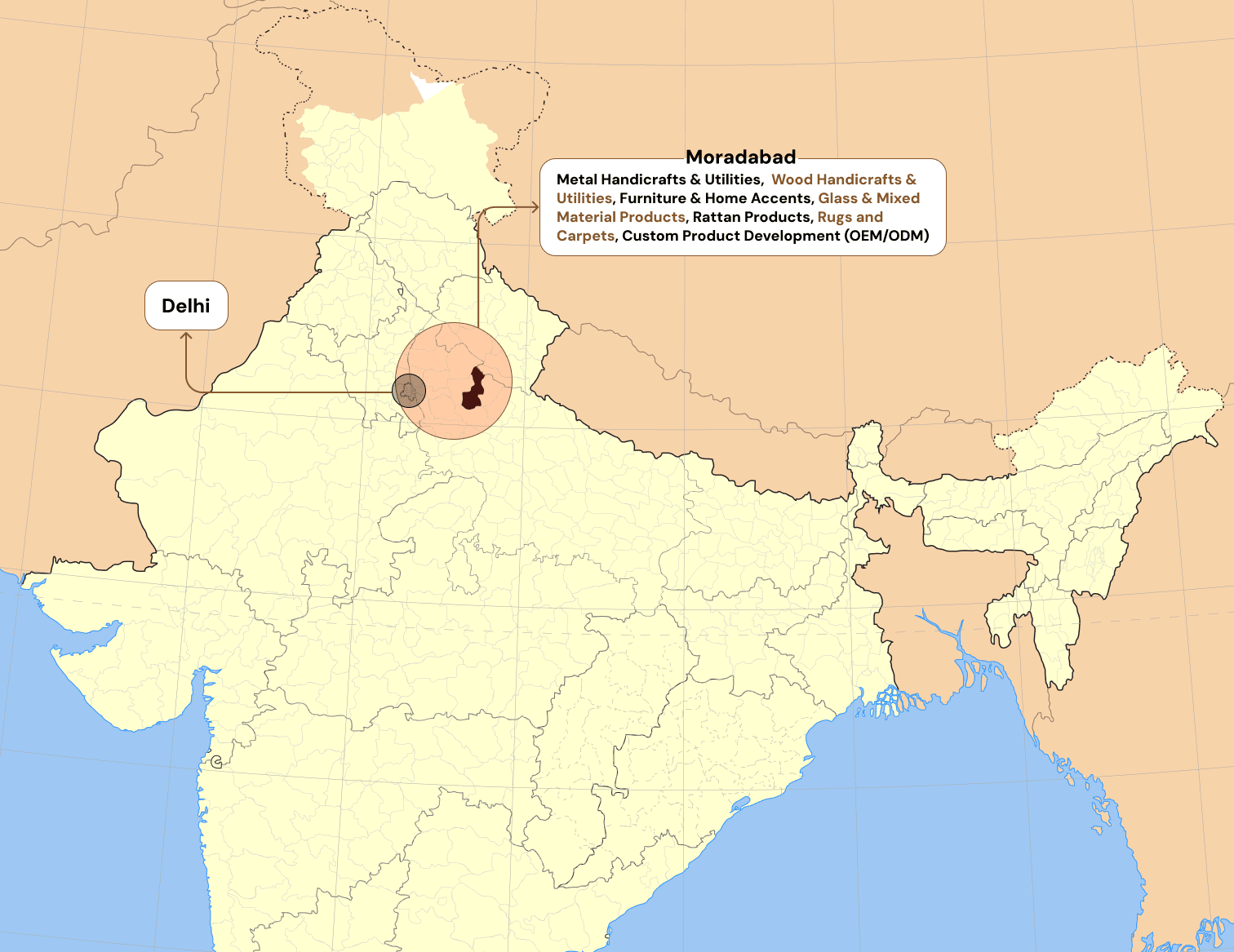
Moradabad is located roughly 167 km from New Delhi, which keeps it within reasonable reach of the capital's transport, customs, and logistics infrastructure. For export shipments, the region is also positioned with access to Nhava Sheva (JNPT), one of Asia's largest container port hubs. That connection matters for buyers because container availability, sailing frequency, and freight forwarding options at a major hub port directly affect how predictable your shipping schedule is, especially during peak season.
The upcoming Noida International Airport (Jewar) is expected to further improve cargo and transit access from the Moradabad region. For buyers who occasionally need air freight for smaller or time-sensitive orders, a nearer, purpose-built cargo airport should, over time, shorten the domestic leg of transit and add flexibility that the region has not historically had.
Neither of these factors replaces the need to vet an individual supplier's own logistics track record, but they explain why Moradabad has remained a viable long-term sourcing base rather than a location that exporters simply inherited.
It is also worth noting that logistics infrastructure and craft skill tend to reinforce each other over time. A cluster with reliable export access attracts more artisans and workshops looking for consistent order volume, while a deep artisan base gives freight forwarders and customs agents in the region steady, predictable cargo to plan around. That two-way relationship is part of why long-established manufacturing clusters like Moradabad tend to be more resilient sourcing locations than newer production zones with less institutional experience in export documentation and shipping.
"Generational craftsmanship" can sound like a soft marketing phrase, so it is worth translating into what it actually means for a B2B buyer evaluating quality and reliability.
The trade-off buyers should be aware of is that a craft-based, workshop-driven cluster is structurally different from a single large vertically integrated factory. Production is often distributed across many smaller units rather than centralized under one roof, which is precisely why the exporter coordinating that network matters as much as the cluster itself.
This is where an export partner's role becomes concrete rather than abstract. Indiecrafto was founded in Moradabad and works directly with a network of 200+ artisan partners across 50+ family workshops within this cluster. Rather than owning a single factory, Indiecrafto's role is to coordinate across this distributed base of artisan workshops: sourcing the right hands for a given technique, managing quality consistency across multiple small units, and translating buyer specifications into production instructions that individual workshops can execute reliably.
On the compliance side, Indiecrafto is EPCH and FIEO registered, holds an IEC license, and is GST registered — the standard documentation overseas buyers should expect from a legitimate Indian exporter handling customs, taxation, and trade body registration correctly. Metal handicrafts sit alongside wood, glass, rattan, home accents, rugs and carpets, and custom B2B programs as one of the company's core sourcing categories, reflecting the fact that Moradabad's craft base, while metal-focused, exists within a broader regional handicraft ecosystem.
For a buyer evaluating metal décor suppliers, understanding the Moradabad cluster changes the questions worth asking. Instead of only asking about unit pricing and minimum order quantities, it is worth asking how a prospective partner is connected to the artisan base, how consistency is managed across multiple workshops, and what documentation exists for export compliance. A supplier's roots in, and relationship to, this specific manufacturing cluster is itself a piece of due diligence — not a footnote.
Moradabad's status as India's historic brass and metalware center did not happen by accident, and it has not stayed relevant by accident either. For overseas buyers, treating the origin cluster as part of the vetting process — alongside samples, certifications, and references — is a small step that can meaningfully reduce sourcing risk over the life of a supply relationship.
Doing supply-chain due diligence? See how we handle quality control for every order that leaves Moradabad.